Putting up a pergola in the garden
A pergola gives a garden height, shade and somewhere for climbing plants to grow.
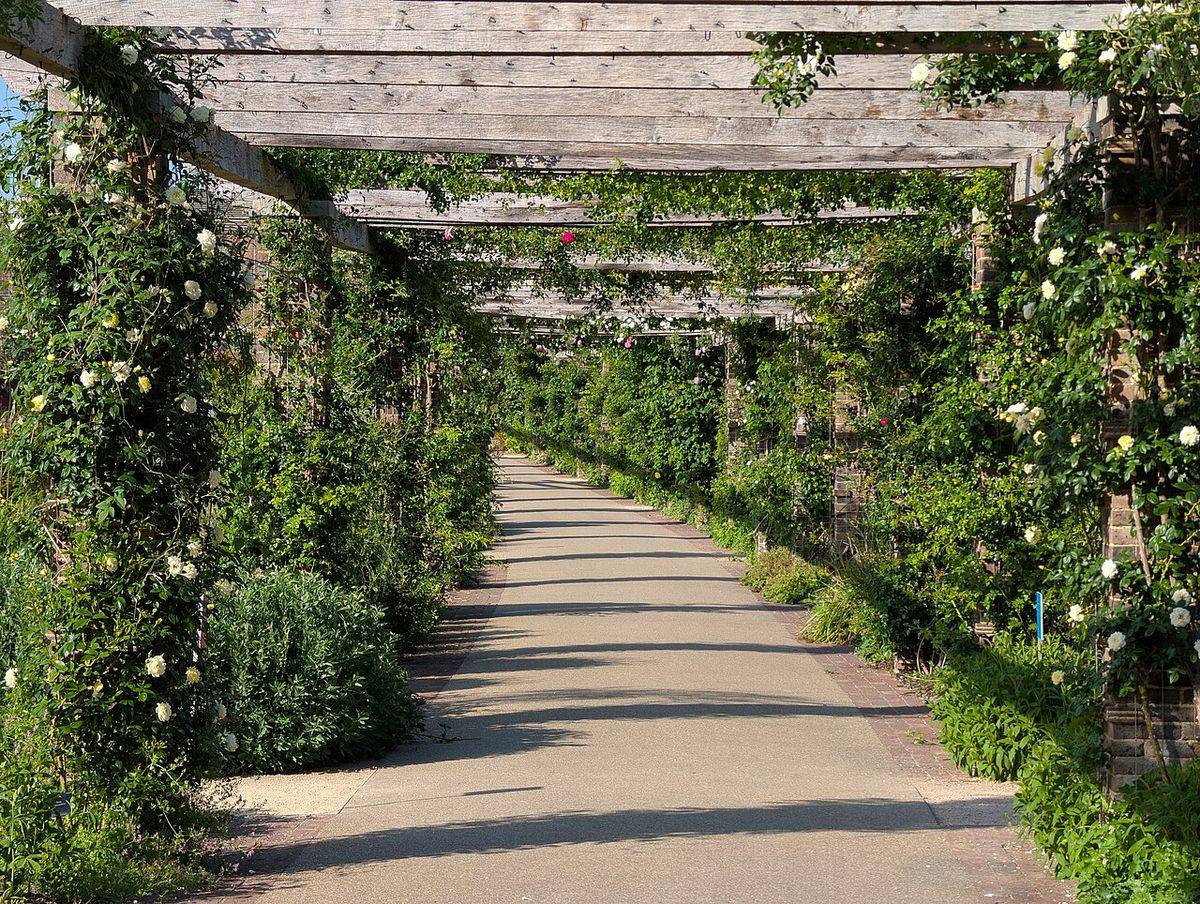
It is an open frame of upright posts with crossbeams along the top, set over a path or a place to eat outside.
Where it goes
Over a path, a pergola becomes a covered walkway. Over a table, it shades an outdoor eating area.
An open, exposed spot puts more strain on the frame from the wind. It also narrows the choice of climbers, because large leaved and evergreen kinds can scorch in drying winds.
Getting the size right
The Royal Horticultural Society (RHS) suggests uprights about 2.7 metres tall. At that height, climbers can trail down a little without getting in anyone's way.
It suggests making the width across the path about the same as the height, for balance. Along each row, the posts can sit anywhere from 0.9 to 3.7 metres apart.
The RHS says a pergola needs a solid build. A well covered frame carries a heavy weight of leaves and stems, and in an open garden it takes a lot of buffeting from the wind.
Plants to grow over it
The RHS suggests rambling roses or strong climbing roses. Ramblers have long, flexible stems that are easy to train up and over the frame.
Clematis that need little or no pruning suit a pergola too. So do summer flowering honeysuckles and other vigorous scrambling climbers.
On a larger pergola, the RHS says it is common to plant two climbers at the foot of each post. A strong climbing rose can then hold up a less vigorous clematis or honeysuckle.
Wisteria and the strongest clematis will cover the crossbeams in time. They may need cutting back to keep them in check.
Planting and early care
At planting time, the RHS suggests angling the young climber towards its post, with a small cane to bridge any gap. Wires or mesh fixed up the post give the new shoots something to be tied to.
Training the shoots straight up covers the top quickly. Winding them round the posts brings flowers lower down, and it helps stop the base of each post going bare.
Young climbers need watering through the summer. Honeysuckle and clematis whose roots dry out are prone to powdery mildew, a white coating on the leaves.
Planning rules in England
In England, the national rules for garden buildings set these limits. No source we found names pergolas, so ask the local planning authority whether a free-standing pergola counts.
- Nothing forward of the house's principal elevation. The government's guidance says that in most cases this is the side facing the main road.
- No more than 2.5 metres high within 2 metres of a boundary.
- Elsewhere, no more than 3 metres high, or 4 metres with a dual pitched roof.
- Garden buildings and extensions together covering no more than half the land around the original house.
If it does, a pergola built to the 2.7 metres the RHS suggests would be over the limit within 2 metres of a boundary.
A structure attached to the house falls under the rules for extensions instead. The same guidance describes a veranda as a platform along the outside of a building at ground level, usually roofed. A veranda needs planning permission.
Any garden building in the grounds of a listed building needs permission. In a conservation area, a National Park or an Area of Outstanding Natural Beauty, so does one at the side of the house. These freedoms apply to houses, not to flats or maisonettes. Planning policy in Wales may differ. The local planning authority can say whether a particular pergola needs permission.
Useful links
- Outbuildings: planning permission (Planning Portal)
- Permitted development rights for householders: technical guidance (GOV.UK)
- Class E, buildings incidental to the enjoyment of a house (legislation.gov.uk)
- Find your local planning authority (Planning Portal)
- Pergolas (Royal Horticultural Society)
- Climbers and wall shrubs (Royal Horticultural Society)
- How to grow wisteria (Royal Horticultural Society)